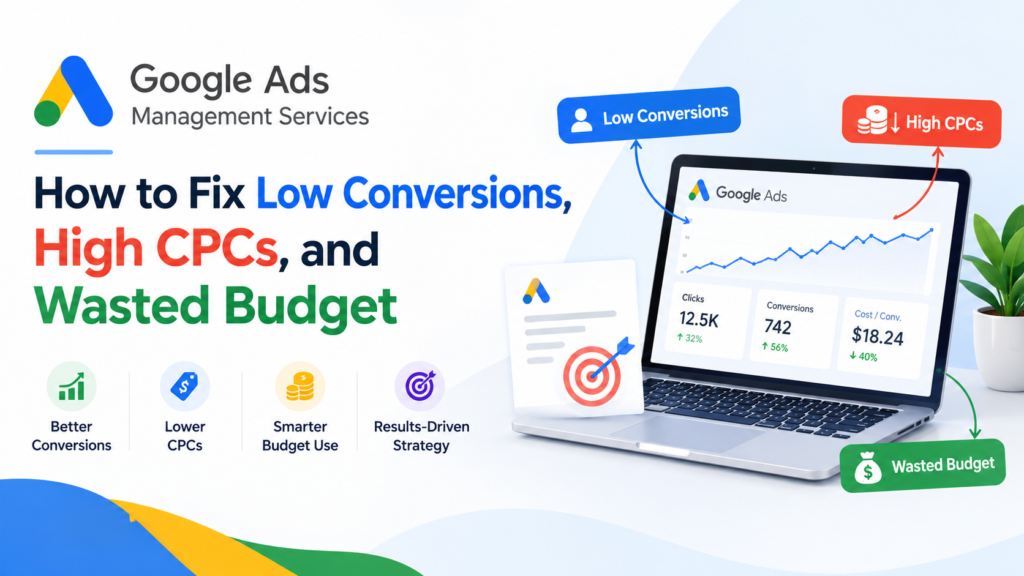
Google Ads is not always smooth. Some days you get clicks. Other days you get almost no conversions. Then the cost per click looks high and the budget feels like it vanishes.
If this is happening, it usually does not come from one thing. Often it is a mix of issues. Your keyword choice might be off. Your ads may not match what people search for. Your landing page might not fit the ad message. Conversion tracking can be wrong or incomplete. Bidding settings may also be too loose.
That is why people look for Google Ads management services. They can help you sort out these weak spots and stop money from leaking out. Proper management does not simply mean increasing bids or creating more ads. It means you know how your money is spent. It also means you can spot which searches bring real business results. Then you keep adjusting the ads using what the numbers show.
Google adds that ad quality is tied to a few key things. One is the expected click through rate. Another is how relevant the ad is. Google also points to the landing page experience. In general, Google says higher quality ads can lead to stronger results and cheaper cost per click.
Why Low Google Ads Conversions Become a Business Problem
Imagine spending $5,000 on Google Ads and receiving thousands of visitors but only a small number of genuine leads. On paper, the campaign may look active. In reality, your advertising budget may not produce enough business.
As I found it over research, this happens when advertisers focus too much on clicks and not enough on conversion quality. A click has value only when it moves the visitor toward a business objective.
Recent benchmark data gives some useful context. WordStream shared new benchmark results for 2025. The study looked at 16,446 ad campaigns in the United States. They ran between April 2024 and March 2025. The report lists an average CTR of 6.66%. It also shows an average CPC of $5.26. The average conversion rate came in at 7.52%. The average cost per lead was $70.11 across industries. Still, the numbers do not match across every industry.
This matters because you should not judge your campaign against one universal number. As per my experience, a business should compare its Google Ads performance with its industry, sales cycle, average order value, and actual profit margin.
The First Problem: Your Ads Get Clicks but Few Conversions
Low conversions often start before the visitor reaches your website.
If someone types “enterprise SEO agency” and your ad takes them to a basic homepage, the match is off. They wanted details on enterprise SEO, but they land on a page that does not clearly answer that need.
Google notes that the landing page experience is part of the Quality Score review. It sits alongside expected click through rate and how relevant the ad is.
As per my research, the solution starts with matching the entire journey. Your keyword should match the ad. Make the ad line up with what is on the landing page.
Then make sure the landing page fits why the visitor clicked in the first place.
Say you run an ad for Google Ads management. That ad should send people to a page that explains how you manage Google Ads. The page should also cover what you do, how you report results, your pricing style, and what they can expect. Do not make them dig through a generic services page just to find the right info.
This simple alignment can remove unnecessary friction.
How High CPCs Can Eat Your Advertising Budget
High CPC does not automatically mean your Google Ads campaign is failing. Some industries naturally have expensive keywords because several advertisers compete for the same commercial searches.
The 2025 benchmark data shows this clearly. In the benchmark dataset, legal services had an average CPC near $8.58. Arts and entertainment came in around $1.60.
The real problem shows up after you keep paying for clicks that do not turn into results.
Say your average CPC is about $8. If 100 users click, you pay roughly $800. Now assume only 2 of those users turn into leads. Your cost per lead ends up near $400. If the value of each customer cannot cover that, you likely need to adjust the campaign.
A Google Ads management firm can review search terms and match types. They can also check locations and device data. They may look at bidding setups, audience signals, and conversion reports to see why the pricey clicks are happening.
The goal should not simply be “get cheaper clicks.” The goal should be to create a better relationship between CPC, conversion rate, cost per lead, and revenue.
Stop Wasted Budget by Checking Search Intent
One of the areas I would check first is the search terms report.
A keyword can look relevant while the actual searches behind it remain too broad. Suppose you advertise web design services using broad keywords. Your ads might appear for searches from students looking for web design courses, people searching for free templates, or users looking for jobs.
Those clicks consume budget without necessarily representing buying intent.
As per my experience, search-term analysis often reveals problems that campaign-level numbers hide. First, you should know what people typed right before they clicked your ad.
After that, you can tighten your keyword targeting. You can also add negative keywords when they fit. It helps to split high intent searches from those meant for research. This matters even more when you set up good conversion tracking. Then you can see which searches lead to real actions. You are not stuck with just traffic numbers.
Landing Pages Can Decide Whether Clicks Become Leads
A strong ad cannot fix a weak landing page.
If an ad says it will provide Google Ads management for small businesses, but the page that opens is just a generic digital marketing layout, many people will feel misled right away.
Google notes that a landing page should be relevant and helpful. That helps both ad quality and the way people experience the site.
From what I saw during my review, you should aim for clear messaging. Skip extra design that adds noise. A visitor should get the point fast, learn who you help, understand why your service is useful, and see the next step to take.
Technical problems matter too. Slow pages, difficult mobile navigation, broken forms, confusing layouts, and unclear calls to action can reduce the value of paid traffic.
This is where technical seo services can also support paid search performance. SEO and Google Ads are not the same. Still, small tech fixes can help how the site feels to people. For example, it can help to make pages work well on phones. It can also help to speed up load times. And it helps when search bots can find and read pages easily. A clearer site layout also makes a difference.
What Link Building Has to Do With Google Ads
At first, Link Building may seem unrelated to paid advertising. However, both activities can support a broader search marketing strategy.
Google Ads can bring immediate paid traffic while SEO works toward organic visibility. Link Building can contribute to authority and organic search performance when you earn relevant, legitimate links from useful websites.
The important point is not to treat Link Building as a direct solution to a poorly managed Google Ads campaign. If your paid campaign has tracking problems or targets the wrong searches, acquiring more backlinks will not fix those issues.
As per my experience, businesses get better results when they treat paid search, technical SEO, content, and Link Building as connected parts of a wider acquisition strategy rather than expecting one channel to solve every marketing problem.
A Case Study Approach to Fixing Google Ads Waste
Consider a business-services advertiser that notices rising CPC and falling lead volume. Instead of immediately increasing the budget, the account needs a structured investigation.
The first step would involve checking conversion tracking. If the account counts low-value actions as conversions, the reported conversion rate may look better than the actual business outcome.
Next, the advertiser can examine search terms and identify irrelevant traffic. Then it can review ad groups and make sure closely related keywords receive relevant ad messaging.
The landing pages should also match each commercial search theme.
This fits what Google says about using Quality Score as a check during troubleshooting. Google does not want people to treat the 1 to 10 number as the goal by itself. When you look into ad quality, Google points you to factors like how relevant the ad feels, what click rate you can expect, and how the landing page comes across.
The benchmark data also shows why industry context matters. For 2025, the business services section came in at roughly a 5.14% conversion rate. The automotive repair and service numbers were much higher, around 14.67%. Comparing a business-services campaign directly with an automotive campaign would therefore create the wrong expectation.
How Google Ads Management Services Can Improve Campaign Control
Professional google ads management services should focus on measurement before expansion.
From what I have found in my notes, the way a team manages ads should tie the money spent to real results for the business. I would start by looking at how the campaign is set up, then check the search terms and what users actually mean with their searches. After that, I would focus on whether the ad text matches the keywords, and whether the landing page makes sense for that same intent. I would also verify that conversion tracking is working, review how bids are set, and check settings for where the ads run and what devices they show on. Lastly, I would examine the budget split to be sure it matches the goals.
A good process also requires regular testing. Ads should not remain unchanged for months while performance declines. Campaign managers need to examine performance data and make controlled changes.
The role of a google ads management company should therefore go beyond campaign setup. It should help identify why performance changed and explain what the available data actually means.
The Future of Google Ads Management
Google Ads continues to become more automated, but automation does not remove the need for strategy.
As per my experience, automation works best when you provide reliable conversion data, appropriate campaign goals, an AI ad generator for useful creative assets, and clear business information.. Poor inputs can still produce poor outcomes.
Google’s recent updates also show continued attention to ad relevance.In an April 2025 update, Google said a test let relevant Search ads from the highest ad spots join auctions on lower pages. In that test, the count of highly relevant ads rose by about 10%. Bottom ad conversions also went up, by around 14%.
The takeaway for advertisers is simple. Matching user intent still matters, even while Google automates more parts of Search ads.
For companies, the next step is not only bigger budgets. It is also using better data. It is improving landing pages. It is sending messages that fit what people want. It is keeping tracking accurate. And it is running tests over time.
Final Thoughts
Low conversions, high CPCs, and wasted Google Ads budgets usually require investigation rather than another budget increase.
As per my research, the strongest starting point is to understand the complete customer journey from search query to conversion. Review what people search, what your ads promise, where the click lands, what action visitors take, and whether your tracking records that action correctly.
Google ads management services can help businesses bring these areas together, while technical seo services and Link Building can support the wider organic search strategy.
As per my experience, the most useful Google Ads question is not “How many clicks did we get?” It is “What business value did those clicks create?” If you start tracking campaigns on that question, you can make smarter calls. You will be able to adjust keywords, ad copy, and landing pages. You can also tune CPCs and decide how to spend your budget.